


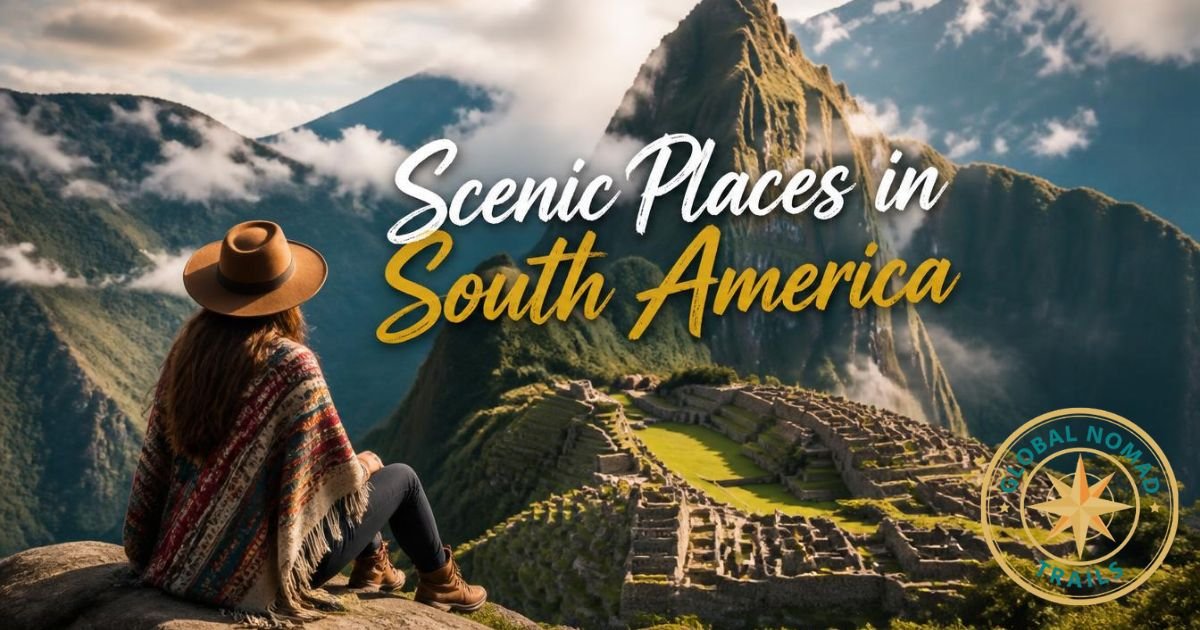
The most scenic places in South America are Machu Picchu, Torres del Paine, Perito Moreno Glacier, the Salar de Uyuni, Iguazú Falls, the Galápagos Islands, the Atacama Desert, Lençóis Maranhenses, Cocora Valley and Rio de Janeiro. They sit in seven countries, so you can’t see them all on one trip. This guide gives each place its best season, how long to stay and what to book ahead.
Timing matters more here than on most continents. The lagoons at Lençóis Maranhenses are nearly dry for part of the year, and the Uyuni mirror effect needs rain. Torres del Paine needs reservations months in advance. Check the “best time” and “book ahead” notes before you choose.
Quick Comparison: Which Scenic Place Fits Your Trip?
| Place | Country | Best for | Best time | Suggested time |
| Machu Picchu | Peru | Ancient ruins in mountains | Dry season, roughly May–Sept | 2–3 days |
| Torres del Paine | Chile | Hiking and granite peaks | Nov–Mar (summer) | 3–5 days |
| Perito Moreno Glacier | Argentina | Glaciers without a long trek | Oct–Mar | 1–2 days |
| Salar de Uyuni | Bolivia | Surreal salt flats | Dec–Mar (mirror) or May–Oct (dry) | 3 days |
| Iguazú Falls | Argentina/Brazil | Waterfalls | Year-round | 1–2 days |
| Galápagos Islands | Ecuador | Wildlife and coastlines | Year-round | 5–7 days |
| Atacama Desert | Chile | Desert, geysers, stargazing | Year-round | 3–4 days |
| Lençois Maranhenses | Brazil | Dunes and freshwater lagoons | June–Sept | 2–4 days |
| Cocora Valley | Colombia | Wax palms and green hills | Dry months, Dec–Mar | 1 day |
| Rio de Janeiro | Brazil | City, beaches and peaks together | May–Oct (cooler, drier) | 3–4 days |
Seasons shift by region and year, so treat these months as general guidance.
Machu Picchu, Peru
Machu Picchu is a 15th-century Inca citadel on a ridge above the Urubamba River, at about 2,430 meters. The stone terraces, the steep green peaks behind them and the cloud that drifts through make it one of the continent’s most photographed sights.
Tickets are the main planning task. Peru’s Ministry of Culture sells them through the official portal, Tu Boleto. As of 2026, the site runs on three circuits split into ten routes. Each ticket carries an entry time and a set route, and you can’t wander freely or re-enter after you leave. Daily visitor caps rise in the high season, and popular dates and train seats sell out well ahead.
Most visitors stay in Aguas Calientes the night before. Add a day in the Sacred Valley, near Cusco, to help your body adjust to the altitude.
- Best for: First-time visitors and history lovers
- Watch out for: Fixed entry windows and altitude
Torres del Paine National Park, Chile
Torres del Paine is the reason many people go to Chilean Patagonia. Three granite towers rise over turquoise lakes, and blue-gray icebergs float near Grey Glacier. The classic W Trek covers roughly 76 km over four to five days.
You can see the highlights without the full trek. Day hikes to Base Torres and boat trips to the glacier work for people with less time. The weather changes quickly, even in summer, so pack for wind and rain.
Booking is the catch. Campsites and Refugio’s need reservations through the park’s operators, and they fill early. Chile’s forest agency CONAF introduced a new route-based entrance fee system on May 1, 2026. Check current fees and rules on the official Pases Parques site before you pay anyone else.
- Best for: Hikers and photographers
- Watch out for: Sold-out beds and fast weather changes
- Base town: Puerto Natales
Perito Moreno Glacier, Argentina
Perito Moreno is part of Los Glaciares National Park, near El Calafate. It stands out because you can see it from raised walkways close to the ice. The front wall rises roughly 70 meters above Lago Argentino, and chunks regularly crash into the water.
Many glaciers retreat. Perito Moreno has been unusually stable over recent decades, which is partly why it draws so many visitors. The walkways suit most ages and fitness levels. Boat trips and guided ice hikes cost extra.
Combine it with El Chaltén, about three hours north, for Fitz Roy’s jagged peaks.
- Best for: Families and anyone who wants big scenery without a long hike
- Watch out for: Midday crowds. Arrive early or late.
Salar de Uyuni, Bolivia
The Salar de Uyuni is the world’s largest salt flat, covering more than 10,000 square kilometers at about 3,650 meters. The scenery changes by season. In the rainy months, roughly December to March, a thin layer of water turns the flat into a giant mirror. In the dry season, the white ground cracks into hexagon patterns, and roads reach more places.
Most people join a tour from the town of Uyuni, from a single day to a three-day loop with lagoons, flamingos and volcanoes. The multi-day route ends near the Chilean border at San Pedro de Atacama.
Rain can close roads and change routes. Choose a tour operator with good safety reviews, and bring warm layers for cold nights.
- Best for: Photographers and people who want an otherworldly landscape
- Watch out for: Altitude, cold nights and wet-season road changes
Iguazú Falls, Argentina and Brazil
Iguazú Falls is a system of roughly 275 separate falls on the border between Argentina and Brazil. The biggest drop, Devil’s Throat, sends water into a roaring horseshoe canyon. Rainforest surrounds the falls, so you often see coatis and colorful birds along the paths.
The two sides give different experiences. The Argentine side has more trails and takes you close to the water. The Brazilian side gives wide panoramas. Many travelers do both, on separate days, and check entry rules for border crossings in advance.
Water volume varies through the year. Heavy rain can raise the river and close some walkways, so check the park’s notices before you go.
- Best for: Waterfall lovers and families
- Base towns: Puerto Iguazú (Argentina) or Foz do Iguaçu (Brazil)
Galápagos Islands, Ecuador
The Galápagos Islands sit about 1,000 km off Ecuador’s coast. Volcanic landscapes, white-sand beaches and wildlife that ignores humans make them scenic in a different way. Sea lions lie on benches, marine iguanas crowd black lava, and giant tortoises roam the highlands.
Most land is protected, and visitors can reach many sites only with certified guides. Foreign adults pay a $200 park fee, and a $20 Transit Control Card is also required. Children’s rates are lower. The park fee has traditionally been paid in cash on arrival, but payment systems can change, so confirm the method before you fly.
A cruise reaches more remote islands. Island-hopping from land costs less and suits shorter trips.
- Best for: Wildlife lovers and snorkelers
- Watch out for: Fees, strict park rules and high costs
Atacama Desert, Chile
The Atacama is one of the driest places on Earth, and it looks like another planet. Salt lagoons, volcano views, red canyons and the pale hollows of Valle de la Luna surround the oasis town of San Pedro de Atacama.
Sunrise at the El Tatio geyser field, at roughly 4,300 meters, is a highlight. Steam rises in the freezing early morning air. The desert’s clear skies also make stargazing excellent, and many local operators run night tours.
Altitude and sun are the main health risks. Drink water, wear sun protection and give yourself a day to adjust.
Lençois Maranhenses National Park, Brazil

Lençóis Maranhenses looks like a desert, but rain makes it special. From about January to June, rainwater fills the hollows between white dunes. By June or July, the lagoons are full and blue-green. The name means “bedsheets,” after the way the dunes ripple.
Most sources put the best window between June and September. Visit in May or September if you want fewer crowds and lower prices. Later in the year, many lagoons dry out, though some stay full.
Most visitors base themselves in Barreirinhas or Santo Amaro and join 4×4 tours. A guide matters here because the dunes are huge and easy to get lost in.
- Best for: Swimmers, photographers and people who want something unusual
- Watch out for: Dry lagoons outside the main season
Cocora Valley, Colombia
Cocora Valley, near the coffee town of Salento, is home to the Quindío wax palm, Colombia’s national tree. These palms can grow up to about 60 meters. They rise out of green, misty hills, which gives the valley a look that feels half forest, half dream.
The popular loop takes roughly four to six hours, depending on pace and route. It includes river crossings and a muddy climb. Wear proper shoes and carry a rain jacket, because clouds often roll in by afternoon. Start early for clearer views.
Salento makes an easy base, and you can add a coffee farm visit in the same trip.
- Best for: Day hikers and coffee lovers
- Watch out for: Mud and afternoon rain
Rio de Janeiro, Brazil
Rio is the only city on this list, and its setting earns it a place. Forested granite peaks rise straight out of the city beside long beaches. Christ the Redeemer stands on Corcovado, and the Sugarloaf cable car climbs a rock about 396 meters above Guanabara Bay.
Go early to Corcovado for better light and fewer people. Sugarloaf works well at sunset. Ipanema and Copacabana are easy beach days.
Keep your belongings secure in crowded areas, and use official transport and tours at viewpoints. See our guide on travel tech tools that improve safety for practical tips.
- Best for: Travelers who want scenery and city life together
- Watch out for: Crowds at viewpoints and petty theft
How to Choose Where to Go
Pick by season first, then by travel style.
- Short trip, one country: Peru for Machu Picchu, or Argentina for Iguazú and Perito Moreno.
- Hiking: Torres del Paine, Cocora Valley or El Chaltén.
- Low effort, high payoff: Perito Moreno Glacier, Iguazú Falls or Rio’s viewpoints.
- Wildlife: Galápagos Islands.
- Photography: Salar de Uyuni and Lençóis Maranhenses, with timing planned carefully.
Distances are huge. Flights between these places often connect through hubs like Lima, Santiago or Buenos Aires. Pairing nearby places, such as Atacama with Uyuni, saves time. For more destination ideas, browse our travel guides.
Frequently Asked Questions
What is the prettiest place in South America?
It’s subjective, but Torres del Paine in Chilean Patagonia is the most common pick, with its granite towers, turquoise lakes and glaciers. Machu Picchu and Prieto Moreno Glacier are the other frequent answers.
What are the top 10 natural wonders of South America?
Amazon Rainforest, Iguazú Falls, Torres del Paine, Perito Moreno Glacier, Salar de Uyuni, Galápagos Islands, Atacama Desert, Lençóis Maranhenses, Angel Falls (Venezuela) and Lake Titicaca.
What are the 7 wonders of South America?
There is no official list, but the most cited are Machu Picchu, Christ the Redeemer, the Amazon, Iguazú Falls, the Galápagos Islands, Salary de Uyuni and Patagonia. Only Machu Picchu and Christ the Redeemer are on the New 7 Wonders of the World list.
What are the top 10 attractions in South America?
Machu Picchu, Christ the Redeemer in Rio, Torres del Paine, Iguazú Falls, Perito Moreno Glacier, Galápagos Islands, Salar de Uyuni, Atacama Desert, Cartagena’s Old Town and Lake Titicaca.
What is the number one tourist destination in South America?
By international arrivals, Brazil now leads, with about 9.3 million visitors in 2025, though many came from neighboring countries. By single attraction, Machu Picchu is the continent’s best-known landmark.
Conclusion
South America’s scenery comes in extremes: ice, desert, rainforest, salt, dunes and mountains. The places above show that range, but they also reward planning. Match the season to the place, book tickets and campsites early, and don’t try to cram too much into one trip.
If you’re unsure where to start, choose one region and go deep. Patagonia, the Peruvian Andes and the Brazilian coast each have enough to fill a full trip. Check official sources for fees, tickets and park rules before you travel, because these details change.