
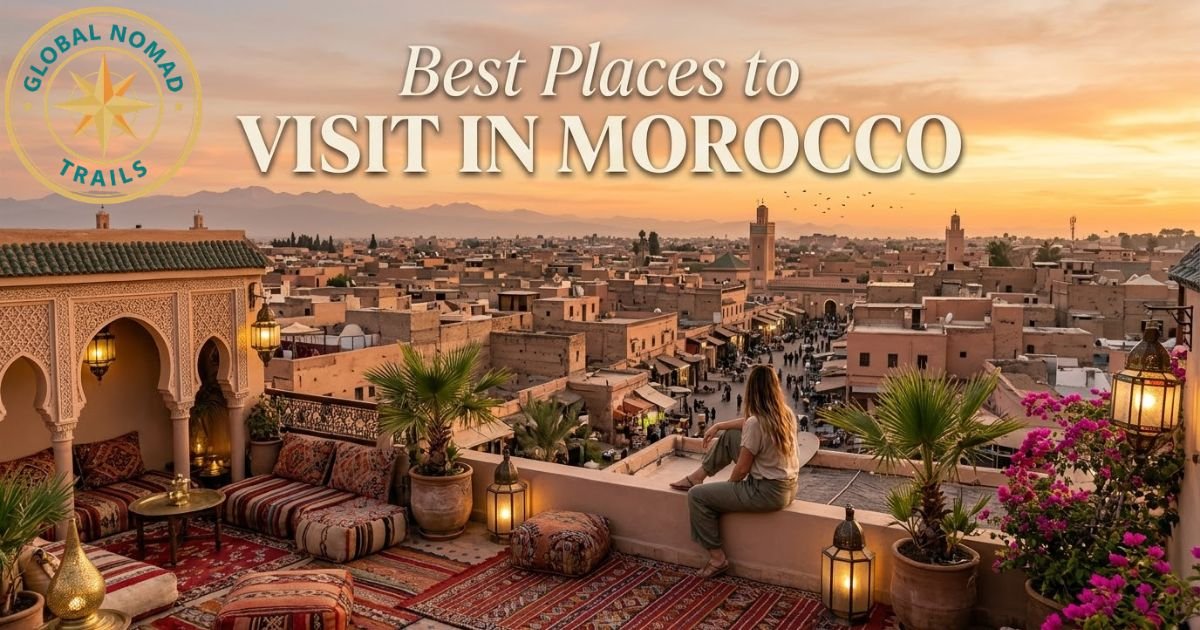
The best places to visit in Morocco for most first-time travelers are Marrakech, Fes, Chefchaouen, the Sahara dunes at Merzouga, Essaouira, Aït Benhaddou and the High Atlas Mountains. Most of these sit on a loop that you can cover in 7 to 10 days. Morocco is bigger than it looks on a map, and some drives take most of a day. This guide shows what each place is best for, how long it needs, and how to link them without wasting time.
You also get the entry rules, safety notes and train information that matter for 2027 planning. Entry rules, advisories and timetables change, so check the official sources linked below shortly before you travel.
Best Places to Visit in Morocco at a Glance
| Place | Best for | Time needed | Best seasons |
| Marrakech | Markets, palaces, first-timers | 2–3 days | Spring and autumn |
| Fes | Medieval medina, history | 2 days | Spring and autumn |
| Chefchaouen | Blue streets, mountain walks | 1–2 days | Spring and autumn |
| Merzouga (Sahara) | Dunes, desert camp | 2 nights minimum | Autumn to spring |
| Essaouira | Coast, seafood, relaxed pace | 1–2 days | Spring and summer |
| Aït Benhaddou | Kasbah, film locations | Half day to 1 night | Spring and autumn |
| High Atlas (Imlil, Toubkal) | Hiking, mountain villages | 1–3 days | Spring and autumn |
1. Marrakech
Marrakech is the easiest place to start. It has an international airport, a huge medina, and enough sights to fill two or three days. The main square, Jemaa el-Fna, is UNESCO-listed. It fills with food stalls and performers in the evening. The 19th-century Bahia Palace is a strong example of Moroccan tilework and carved cedar, and it is best in the early morning before the tour groups arrive.
Marrakech suits first-time visitors, couples and anyone who wants a comfortable base. The main drawbacks are crowds, heat in summer, and persistent sellers in the souks. Agree prices before you accept anything. You can also use Marrakech as a launch point for day trips to the Atlas Mountains and the coast.
2. Fes
Fes is the best place in Morocco for history. Its old city, Fes el-Bali, is a medieval medina of narrow lanes with no cars. The Al-Qarawiyyin University, founded in 859, is often called the world’s oldest continuously operating educational institution. The Al-Attarine Madrasa is a smaller, quieter stop for tilework and carved wood.
Fes is harder than Marrakech. The lanes confuse almost everyone, and fake guides are common. If you hire a guide, choose one with an official badge. Allow two days. Fes pairs well with Chefchaouen to the north and the Sahara to the south.
3. Chefchaouen
Chefchaouen, known as the Blue Pearl, is a small mountain town in the Rif Mountains, famous for its blue-washed lanes. It works best as a slow stop, not a checklist. Walk the medina early, then hike or sit at a café in the afternoon. One night is enough for most people, and two nights suit hikers.
The town is popular on social media, so the main lanes get busy by mid-morning. Go early, or explore the quieter side streets away from the main square. Pair it with Fes or Tangier.
4. Merzouga and the Sahara
The Erg Chebbi dunes near Merzouga are the most accessible Sahara landscape in Morocco. A typical visit includes a camel ride at sunset, a night at a desert camp, and sunrise over the dunes. Erg Chigaga near M’Hamid is more remote and has higher dunes, and it suits travelers who want fewer crowds.
Merzouga is far from the main cities. Tour providers report drives from Marrakech or Fes that can take most of a day. Plan at least two nights in the region, not rush overnight. Choose a camp carefully, ask how many people it holds, and confirm what the price includes. A 3-day tour from Fes to Marrakech via Merzouga is a common route. It passes the Dades and Todra gorges, which are worth a stop if your guide offers them.
5. Essaouira
Essaouira is a fortified Atlantic port with a whitewashed medina, a working fishing harbor and a relaxed arts scene. It is a good break from the intensity of Marrakech. Come for fresh seafood, the ramparts and the beach. It also hosts the annual Gnaoua World Music Festival.
The wind is strong here, which makes the town a popular kitesurfing base but not always ideal for sunbathing. Buses link Marrakech and Essaouira, with a journey of about three hours. Stay one or two nights.
6. Aït Benhaddou and Ouarzazate
Aït Benhaddou is a fortified village, or ksar, of earthen buildings in the southern foothills of the High Atlas Mountains. UNESCO lists it as a World Heritage Site, and film crews have used it for many productions, including Game of Thrones. Nearby Ouarzazate has film studios and acts as a practical base.
Most travelers see Aït Benhaddou on the road between Marrakech and the Sahara. If you can spare a night, stay nearby and walk the ksar in the evening or early morning, when the crowds thin out and the light is softer. Our guide to planning a road trip covers route planning and driving basics that apply to long Moroccan drives.
7. The High Atlas Mountains
The High Atlas Mountains rise close to Marrakech and offer a very different Morocco. Imlil is the usual base for Jebel Toubkal, which at 4,167 meters is the highest peak in North Africa. Spring (March to May) is a good season for hiking, as the lower slopes are green. In winter, snow can cover the higher routes.
You can walk to Berber villages on short day hikes. For Toubkal itself, go with a licensed mountain guide. Check weather and trail conditions before you set out.
Also Worth a Stop
If you have more time, consider these additions:
- Rabat and Casablanca: The capital and the commercial hub, linked to Tangier by the Al Boraq high-speed train.
- Meknes and Volubilis: Roman ruins and an imperial city, an easy detour between Fes and Rabat.
- Taghazout: A beach town known for surfing, near Agadir.
- Ouzoud Falls: Waterfalls with Barbary macaques in the Atlas foothills.
- Tangier: A port city facing Spain across the Strait of Gibraltar.
Morocco’s architecture also connects it to southern Spain. If you plan to visit both, our guide to the Real Alcázar of Seville shows how Moorish design shaped that city.
Planning Your Morocco Trip
Entry rules
Travelers from about 70 countries, including the US, Canada, Australia, New Zealand, the EU and the UK, can enter Morocco as tourists without a visa for up to 90 days. Other nationalities may need an e-visa or an Electronic Travel Authorization (AEVM). You apply through the official Access Maroc portal. Check your passport’s requirements and validity before booking.
Best time to visit
Spring (March to May) and autumn (September to November) work best for most itineraries. Temperatures are milder in the cities and the desert, and the mountains are good for hiking. Summer is very hot inland, though the coast stays cooler.
Getting around
Morocco’s rail network is strongest in the north. The Al Boraq high-speed train links Tangier and Casablanca via Rabat in roughly 2 hours. Classic Al Atlas trains connect Casablanca with Fes and Marrakech. You can check timetables and books on the ONCF website. Some routes require reservations. Buses link Marrakech with Essaouira and Agadir. For the Sahara, the High Atlas and Aït Benhaddou, most travelers book a guided tour or hire a driver.
Safety and common scams
The US State Department currently lists Morocco at Level 2, “Exercise increased caution,” mainly due to terrorism risk. Violent crime against tourists is uncommon. Petty theft, fake guides and taxi disputes are more common, especially in the medinas. Insist on the meter in taxis, use badged guides, and keep bags and phones secure in crowded areas. Check your own government’s advisory before you go, and carry travel insurance that covers medical evacuation.
Money and apps
Install offline maps, a translation app and an eSIM before you arrive. Our list of must-have travel apps covers the main options. Carry some cash for small purchases and taxis, because many shops and food stalls do not accept cards.
What to wear
Dress modestly in medinas and rural areas. Light, loose layers cover both shoulders and knees and work in the heat. Our travel fashion guide for women offers outfit ideas for warm and conservative destinations.
Sample Route: 7 to 10 Days in Morocco
- Days 1–3: Marrakech, with a day trip to the Atlas Mountains or Essaouira.
- Days 4–5: Drive to Aït Benhaddou and Ouarzazate, then onward toward Merzouga.
- Days 6–7: Sahara camp, then north to Fes.
- Days 8–9: Fes medina.
- Day 10: Chefchaouen, then Tangier or Casablanca for your flight.
You can run this route in reverse from Tangier or Casablanca. Add a day or two if you want to include Essaouira or a Toubkal hike.
FAQ,s
What is the number one place to visit in Morocco?
Marrakech is the most visited and the easiest starting point for first-time travelers.
How many days do you need in Morocco?
Seven to ten days covers the main highlights, including the Sahara. A week works if you skip a stop or two.
What is the best month to visit Morocco?
April, May, October and November offer comfortable temperatures across most regions.
Is Morocco safe for tourists?
Most visits go smoothly. Take normal precautions against petty theft and scams, and check your government’s advisory.
Do I need a visa for Morocco?
Many nationalities can stay up to 90 days without a visa. Others need an e-visa or AEVM, so check the official portal.
Conclusion
The best places to visit in Morocco differ widely in pace and landscape. Marrakech and Fes give you the cities, Chefchaouen and Essaouira give you slower stops, and Merzouga, Aït Benhaddou and the High Atlas give you the wide open landscapes. Choose three or four, not all seven, unless you have at least ten days.
Travel distances in Morocco are long, so group nearby stops and avoid one-night stays where you can. Confirm entry rules, safety advisories and train times shortly before you leave. Those details can change, and a few minutes of checking will make the rest of the trip easier.