


The Business Travel Visa from TD Canada Trust is a Canadian small-business credit card designed to help companies manage everyday business expenses while earning travel rewards and accessing selected insurance benefits. It can be used for eligible purchases such as business travel, dining, recurring bills, foreign-currency transactions, transportation, and other operating expenses. Unlike an immigration or work visa, the Business Travel Visa is a financial product. It does not provide permission to enter Canada, work in another country, or conduct business across international borders. Instead, it gives eligible Canadian businesses a way to organize company spending and earn TD Rewards Points from qualifying purchases.
For 2026, the card has a $149 annual fee, a 19.99% purchase interest rate, and a 22.99% cash-advance interest rate. TD’s current public offer, effective September 1, 2026, advertises up to $1,300 in value, including opportunities to earn up to 200,000 TD Rewards Points and receive first-year annual-fee rebates for the primary cardholder and up to four additional cardholders, subject to the offer’s terms and conditions. The card also stands out because its rewards are not limited to airline tickets. Eligible spending in categories such as dining, public transit, recurring bill payments, foreign-currency purchases, streaming and digital media, and other business expenses can contribute to the company’s TD Rewards balance. This can make the card relevant to businesses that have regular operating costs in addition to travel expenses.
What Is the TD Business Travel Visa?
The Business Travel Visa is a TD Canada Trust business credit card for Canadian small-business owners. It lets eligible businesses separate business spending from personal purchases while earning TD Rewards Points on eligible transactions. The card is designed for companies that have regular business expenses and may also spend on flights, hotels, car rentals, meals, foreign-currency purchases, recurring bills, and other operating costs. The Business Travel Visa can therefore be useful beyond travel itself. A company can earn rewards from ordinary business spending and then use those points toward eligible travel or other redemption options.
Business Travel Visa vs. an Immigration Visa
The name can cause confusion. The Business Travel Visa is not a document that lets you enter Canada or another country for business. It is a financial product issued by TD Canada Trust. If you are researching immigration, visitor, or work authorization, this card is unrelated to those requirements. The card instead helps eligible businesses pay for expenses and earn TD Rewards Points. This distinction matters because a search for “business travel visa” can refer either to a business credit card or to immigration permission. This article covers the TD credit card.
2026 Card Snapshot
| Feature | Current 2026 details |
| Card | TD Business Travel Visa |
| Annual fee | $149 |
| Purchase interest rate | 19.99% |
| Cash-advance interest rate | 22.99% |
| Travel booking earn rate | 9 TD Rewards Points per $1 through ExpediaForTD.com |
| Selected bonus categories | 6 points per $1 |
| Other eligible purchases | 2 points per $1 |
| Travel medical insurance | Up to $2 million for eligible emergencies |
| Primary market | Canadian small businesses |
Rates and benefits can change, so applicants should confirm the current TD terms before applying.
Business Travel Visa Rewards: How Points Are Earned
The Business Travel Visa uses TD Rewards Points rather than airline-specific miles.
The current TD page lists these earning rates:
- 9 TD Rewards Points for every $1 spent on eligible travel booked online through ExpediaForTD.com using the card.
- 6 points per $1 on dining.
- 6 points per $1 on electric-vehicle charging.
- 6 points per $1 on public transit.
- 6 points per $1 on streaming, digital gaming, and media purchases.
- 6 points per $1 on recurring bill payments.
- 6 points per $1 on foreign-currency purchases.
- 2 points per $1 on other eligible business purchases.
The Business Travel Visa therefore rewards more than flights and hotels. A business with regular operating expenses may earn points from several spending categories.
Using ExpediaForTD.com for Business Travel
One of the card’s distinctive features is the enhanced rewards rate for travel booked through. With the Business Travel Visa, eligible online travel purchases through ExpediaForTD.com can earn 9 TD Rewards Points per $1. TD’s welcome guide says the platform can be used for travel needs such as flights, hotels, car rentals, and attractions. For a business that already books travel online, this can make the booking channel an important part of its rewards strategy. However, companies should compare the total booking price, cancellation rules, and other terms before choosing a booking channel solely for rewards.
Business Travel Visa Welcome Offer in 2026
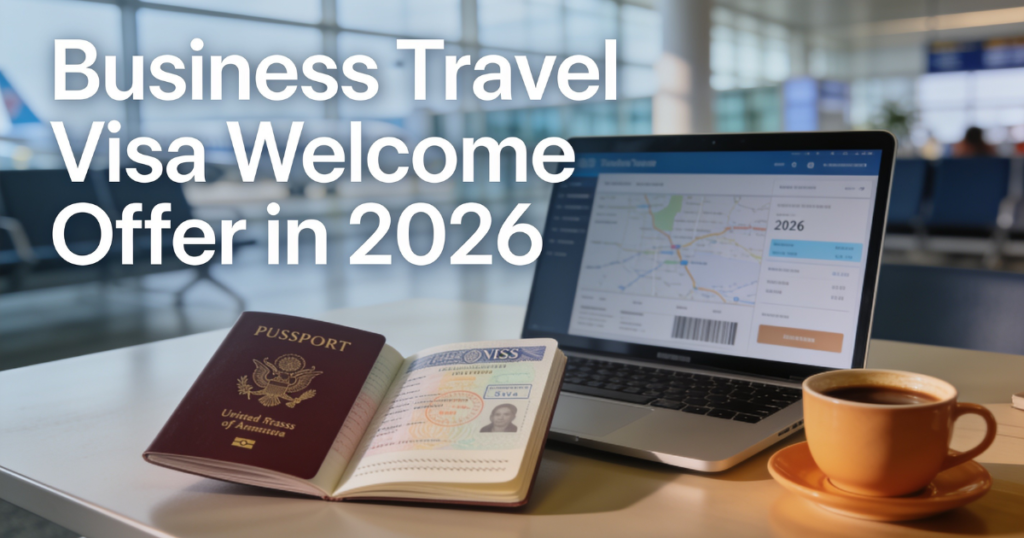
The Business Travel Visa currently has a promotional offer that began September 1, 2026.
TD’s main application page advertises up to $1,300 in value. The offer includes:
- 30,000 TD Rewards Points after the first purchase.
- 120,000 additional points after $15,000 in purchases within the first 180 days.
- 30,000 additional points after $25,000 in purchases within the first 365 days.
- 20,000 points after making a purchase during the 15th billing cycle.
- A first-year annual-fee rebate for the primary cardholder.
- First-year annual-fee rebates for up to four additional cardholders, when the offer conditions are met.
The Business Travel Visa offer is conditional and can be changed, withdrawn, or extended by TD. Businesses should review the current terms before applying rather than relying on an older promotion.
Business Travel Visa Annual Fee and Interest Rates
The Business Travel Visa currently has a $149 annual fee. TD lists a 19.99% interest rate for purchases and 22.99% for cash advances on its current card comparison page. For a business that pays the statement balance regularly, the annual fee may be easier to evaluate because interest charges can be avoided on purchases when the account is managed according to the card agreement. Businesses that carry balances should pay close attention to the applicable interest costs. The annual fee is only one part of the card’s cost. Companies should also review transaction fees, cash-advance terms, foreign-currency conditions, and any other applicable charges.
Business Travel Visa Travel Insurance
Travel insurance is a major part of the card’s corporate travel appeal. The Business Travel Visa includes travel medical insurance with up to $2 million of coverage for eligible emergency medical expenses while traveling outside the cardholder’s province or territory, including international travel. TD’s welcome guide states that coverage normally applies for the first 15 days of a trip. If the cardholder or spouse is age 65 or older, the initial coverage period is four days. TD also says additional top-up coverage may be available for longer trips. Insurance has detailed eligibility conditions, exclusions, and limitations. Cardholders should read the certificate of insurance before assuming that a particular medical expense or trip is covered.
Trip Cancellation and Interruption Coverage
The Business Travel Visa also includes trip cancellation and trip interruption insurance under the applicable terms. TD currently describes trip cancellation coverage of up to $1,500 per insured person, with a $5,000 maximum for all insured persons on the same covered trip. For trip interruption, TD lists up to $5,000 per insured person, with a maximum of $25,000 for all insured persons on the same covered trip. These benefits are subject to eligibility rules and exclusions. The insurance certificate is the controlling document, so businesses should review it before relying on coverage.
Flight and Trip Delay Protection
The Business Travel Visa includes flight/trip delay insurance. TD’s welcome guide says that when an eligible flight or trip is delayed for more than four hours, each insured person may receive up to $500 for reasonable and eligible hotel, motel, and restaurant expenses, provided the applicable conditions are met. One important condition is that the full cost of the flight must be charged to the business card and/or paid with TD Rewards Points, according to the coverage terms. That makes it important to understand how the trip was purchased before assuming the insurance applies.
Common Carrier Travel Accident Insurance
Another travel benefit is common carrier travel accident insurance. The Business Travel Visa provides up to $500,000 of coverage for covered losses while traveling on a common carrier, such as a plane, train, bus, or ferry. The benefit has specific definitions and exclusions. The card’s insurance certificate should be checked for the exact circumstances covered.
Additional Cardholders for Business Spending

The Business Travel Visa can also help businesses separate employee spending from personal expenses by issuing additional cards. TD’s current promotional offer includes first-year annual-fee rebates for up to four additional cardholders, provided the applicable offer conditions are satisfied. Additional cards can be useful when employees regularly purchase travel, meals, transportation, supplies, or other business expenses. Businesses should establish internal spending limits and approval procedures before giving employees access to a company credit card.
Visa Saving sedge
The Business Travel Visa also provides access to Visa Saving sedge when the eligible card is linked to the program. TD says Visa Saving sedge provides access to selected offers from participating merchants, potentially covering categories such as gas, restaurants, and business services. Saving sedge offers are separate from TD Rewards Points. Businesses should check the current offer terms and participating merchants rather than assuming every purchase qualifies.
Managing Business Expenses With the Card
The Business Travel Visa can help create a clearer separation between business and personal expenses.
Using a dedicated business card can make it easier to:
- Track employee purchases.
- Review travel spending.
- Organize receipts.
- Monitor recurring payments.
- Separate business costs from personal purchases.
- Review spending by cardholder.
- Build a record of business credit activity.
TD states that its business credit cards can help businesses separate business spending from personal spending while building business credit history. The card does not replace accounting software or internal expense controls. A business still needs a process for receipts, approvals, reimbursements, and tax records.
Redeeming TD Rewards Points
The Business Travel Visa gives cardholders several ways to use TD Rewards Points. TD says cardholders can redeem points toward eligible travel booked through ExpediaForTD.com. Points can also be used toward eligible past purchases, Amazon.ca purchases, or to help reduce the card balance, subject to the applicable program terms. Travel redemption can be especially relevant for businesses that regularly purchase flights, hotels, car rentals, or attractions. Before redeeming points, compare the available redemption value and any applicable restrictions.
Who May Find the Card Useful?
The Business Travel Visa may fit businesses with regular travel and operating expenses that can benefit from TD Rewards Points.
It may be relevant for:
- Consultants who travel for client meetings.
- Small companies with regular employee travel.
- Businesses with recurring operating bills.
- Companies that make frequent foreign-currency purchases.
- Owners who want a dedicated business credit card.
- Businesses that want travel-related insurance benefits.
The fit depends on spending patterns, payment habits, travel frequency, and how the company values the available rewards.
What Businesses Should Consider Before Applying
The Business Travel Visa has useful travel and spending features, but businesses should look beyond the headline welcome offer.
Consider these questions:
How much does the business spend each month?
Higher eligible spending can create more opportunities to earn rewards, but rewards should never justify unnecessary purchases.
Does the business pay the balance in full?
If the company regularly carries a balance, interest costs can outweigh the value of rewards.
Does the company book travel through ExpediaForTD.com?
The highest advertised travel earning rate applies to eligible online travel purchases through ExpediaForTD.com. Businesses that use other booking methods should consider how that affects their rewards.
Will employees need additional cards?
If several employees travel, additional-cardholder fees and controls become relevant.
Will the insurance actually match the company’s trips?
Companies should review coverage periods, eligibility requirements, exclusions, and age-related rules before depending on the included insurance.
Business Travel Visa: Important Limitations
The Business Travel Visa should not be viewed as a replacement for a dedicated corporate travel-management system.
Businesses with large travel programs may need additional tools for:
- Centralized booking.
- Employee travel policies.
- Approval workflows.
- Expense reporting.
- Vendor management.
- Travel data analysis.
- Duty-of-care programs.
A small business with straightforward travel spending may have different needs from a company managing dozens or hundreds of travelers. The card should therefore be evaluated as one part of the company’s financial and travel process.
Is the 2026 Welcome Offer Right for Your Business?
The Business Travel Visa welcome offer requires substantial spending to earn some of the advertised rewards. The current offer includes a $15,000 spending requirement within 180 days for one major bonus and a $25,000 requirement within 365 days for another. A business should only pursue those bonuses if the spending fits its normal budget. Buying unnecessary products or accelerating expenses simply to reach a credit-card bonus can reduce the financial value of the offer. A better approach is to compare the card’s regular rewards and benefits with the business’s existing expenses.
How to Maximize the Card Responsibly
The Business Travel Visa can be used more effectively when spending follows the company’s normal operating needs.
Practical strategies include:
- Use the card for eligible recurring business bills.
- Use it for eligible foreign-currency business purchases.
- Book qualifying travel through ExpediaForTD.com when the total cost and terms make sense.
- Give additional cards only to employees who need them.
- Set internal spending rules.
- Review monthly statements.
- Redeem TD Rewards Points based on the available value.
- Pay balances on time and manage credit use carefully.
- Track the dates and requirements for promotional bonuses.
- Read the insurance certificate before relying on coverage.
The goal should be to earn rewards from spending the business already needs, not to increase spending for points.
Frequently Asked Questions
Is the TD Business Travel Visa a real travel visa?
No. The Business Travel Visa is a TD Canada Trust business credit card. It does not provide immigration permission, work authorization, or entry rights into Canada or another country.
How much is the annual fee?
The Business Travel Visa currently has a $149 annual fee. TD’s promotional offer can provide a first-year fee rebate when the applicable conditions are met.
How many points does the card earn on travel?
The Business Travel Visa currently earns 9 TD Rewards Points per $1 on eligible online travel purchases through ExpediaForTD.com using the card.
Does the card include travel medical insurance?
Yes. The Business Travel Visa includes up to $2 million in eligible emergency travel medical coverage, with specific coverage periods and conditions.
Can employees receive additional cards?
Yes. TD allows additional cardholders on the business account. Fees and promotional rebates depend on the current terms and offer.
Does the card charge foreign transaction fees?
Foreign-currency purchases can earn 6 TD Rewards Points per $1 under the current earn structure. Businesses should separately review the cardholder agreement for applicable foreign-currency conversion terms and fees.
Who should consider this card?
The Business Travel Visa may be relevant to Canadian small businesses that want to combine business spending, TD Rewards Points, and travel-related insurance. The right choice depends on the company’s spending and payment habits.
Conclusion
The Business Travel Visa is a Canadian small-business credit card that combines TD Rewards Points with travel-related insurance and business spending features. Its current 2026 offer includes a $149 annual fee, multiple bonus categories, and a promotional opportunity to earn additional TD Rewards Points. Its practical value depends on how a company actually spends. Businesses that already have regular travel, dining, foreign-currency, recurring-bill, and other eligible expenses can evaluate the rewards against their normal spending patterns.
Before applying, review TD’s current offer, annual fee, interest rates, rewards rules, and insurance certificates. Promotional terms can change, and insurance benefits always depend on their detailed conditions.